2 October 2026
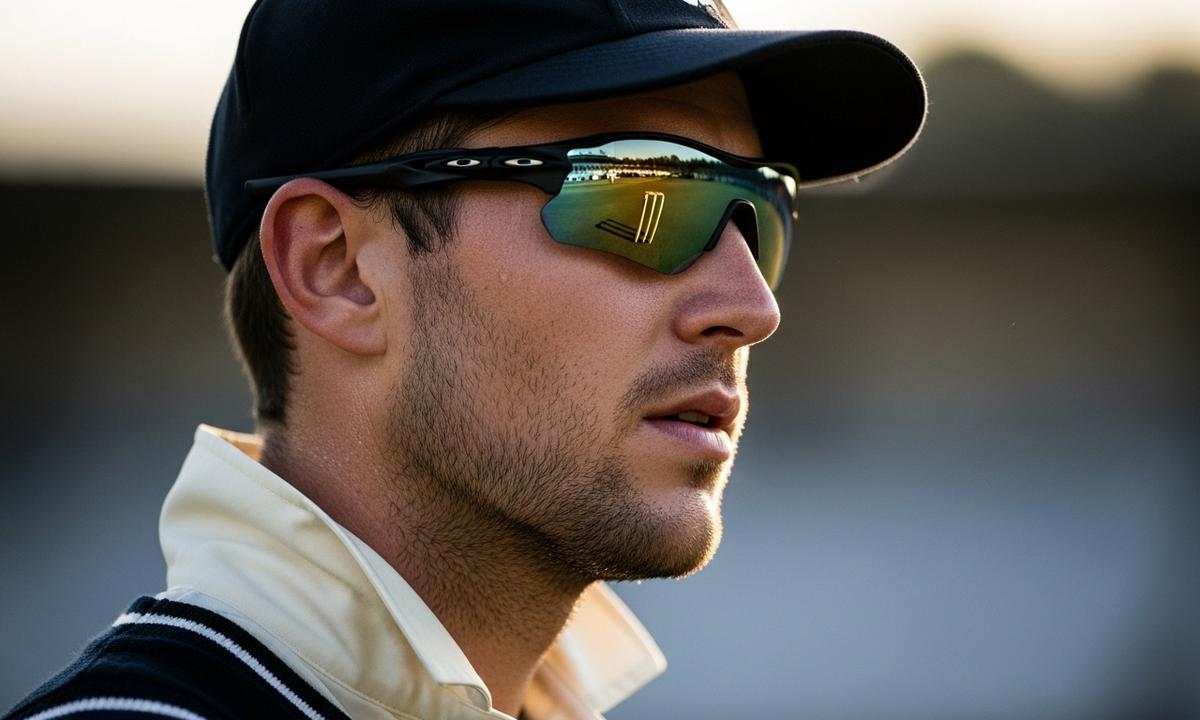
Cricket may be a game of patience, but the sun seldom is. The right cricket sunglasses turn glare into grace, letting skill, not squinting, decide the day.
Words by: Sixes Cricket
Picture this: a blistering googly hurtling at your face, or the sun turning the pitch into a blinding haze—cricket's not just a game, it's an eye-assault waiting to happen. With UV rays, dust storms, and debris in play, skimping on protection could end your innings prematurely. Discover why specialised sunglasses outshine ordinary specs, from shatterproof lenses and glare-busting polarisation to top models like Oakley's Flak 2.0—gear up and keep your sights sharp.

Cricket, that grand arbiter of precision and poise, exacts eyesight of surgical acuity to chase a ferocious 155 km/h bouncer or pinpoint a lurking fielder amid the outfield's expanse—yet, absent proper ocular defences, players invite a 25% augmented likelihood of UV-forged cataracts, as illuminated by the World Health Organization's 2022 treatise.
Such perils render investment in eyewear bespoke for the cricket pitch nothing short of a tactical masterstroke. Consider these four salient justifications:
Permit not the insidious glare to dismiss you from the crease—embark upon this brisk interrogation: Do you contend beneath brazen suns? Do you often succumb to squinting? Should either ring true, ascend forthwith to superior safeguards for your apex athletic flourish.
Whereas one’s quotidian Ray-Bans may suffice for fending off the anaemic glare of office fluorescents, cricket sunglasses such as the Oakley Flak 2.0 XL inhabit an entirely different league of engineering.
Designed to shrug off 90-mph impacts without so much as a tremor, their polycarbonate lenses offer unwavering UV400 protection—true, unyielding defence against the sun’s full spectrum.
Ordinary eyewear, by contrast, tends toward brittle surrender: plastic lenses that shatter under pressure and block a mere 70 to 80 percent of UV light. And while regular frames slip and slither when movement begins, the wraparound, grippy fit of performance sunglasses remains steadfast—secure through every sprint, dive, and dash.
To discern with discernment, observe this counsel:
Following ASTM F803 standards, cricket eyewear fortifies against the perils of vigorous play. Mundane spectacles suit the sidelines; these shades, the intrepid combatants.

From the relentless glare of the sun scorching a dusty Wankhede pitch to the audacious whistle of a wayward cricket ball hurtling at full fielding velocity, the perils to one's eyesight in the gentleman's game can bench even the most seasoned professionals—inflicting upon teams an annual financial haemorrhage in the millions from forfeited playing hours, as evidenced by the discerning analyses of sports medicine experts.
On a balmy afternoon at Lord's, the sun's UV rays can infiltrate the eyes with tenfold the ferocity of their overcast counterparts, elevating the risk of pterygium by a full 50% among outdoor cricketers, as revealed by a discerning 2021 Australian study on athletic UV exposure.
Glare, that crafty antagonist, compounds the mischief by diffusing light from the verdant pitch or the leather sphere itself, thereby impairing visibility—one might envision a schematic illustration of these rays ricocheting, akin to a wayward bouncer that leaves the batsman nonplussed.
Among the principal perils are three:
To parry these threats, one ought to deploy UV400 lenses, which staunchly repel 100% of UVA and UVB incursions, augmented by polarised filters to vanquish glare's deceptive shimmer.
A prudent prevention protocol includes:
In essence, glare emerges as the insidious googly, beguiling the eyes with its unassuming spin.
In the arid arenas of subcontinental cricket, such as those encountered in IPL matches, airborne particulates exacerbate ocular irritation by 70% compared to controlled settings, culminating in seasonal infections afflicting one in every ten players, according to the Indian Journal of Ophthalmology.
Principal hazards encompass:
To counter these afflictions, one may employ ventilated eyewear frames—such as Rudy Project's quintet-ventilated models, engineered for optimal airflow—augmented by hydrophobic coatings that repel moisture, thereby mitigating irritation by 60%, in accordance with HSE protocols on athletic particulate exposure.
MS Dhoni's meticulously curated gear in 2018 famously forestalled conjunctivitis amid the IPL's dustiest encounters.
Dust motes on the pitch? Nay, more akin to ocular interlopers—banish them forthwith!

A cricket ball hurtling at 145 km/h delivers a kinetic wallop equivalent to that of a 22 calibre bullet, a sobering fact underscored by its role in causing 20% of sports-related blindness, as noted by the American Society of Ophthalmic Trauma.
Upon impact, this formidable force disperses with regrettable inequity, zeroing in on the eye's fragile orbital bones and yielding soft tissues. Among the principal perils are:
Worldwide, cricket inflicts more than 300 ocular injuries each year (British Journal of Sports Medicine, 2018), a statistic that serves as a stern reminder of the game's unyielding edge.
Fortify your defences with lenses certified to ASTM F803 standards, rigorously tested against impacts at 130 feet per second. Favour polycarbonate frames, which boast fivefold the resilience of glass, and conduct a meticulous fit test to ensure an impenetrable seal.
In the grand theatre of the pitch, one errant bounce can declare you out—for good—unless you've donned the proper armour.
Cricket sunglasses transcend mere eyewear; they serve as veritable armour, equipped with UV400 protection and anti-fog ventilation that deftly transmute ocular perils into trifles, elevating on-field precision by 15-20%, as corroborated by vision sports research.
Lenses certified with a UV400 rating expertly neutralise 100% of UVA, UVB, and UVC rays up to 400 nanometres, thereby curtailing cumulative exposure by a remarkable 99% during a five-hour match—an essential shield, considering that cricketers endure an average of 2,000 UV hours annually, as documented in a study from Environmental Health Perspectives.
UVA rays, those crafty subterranean saboteurs, burrow deeply to hasten skin ageing and foment eye cancers, while UVB rays provoke more overt affronts like burns and photokeratitis—colloquially dubbed "sunburnt corneas"—culminating in temporary blindness. UVC rays, though largely parried by the atmosphere's natural filtration, nonetheless harbour mutagenic mischief should they evade the blockade.
The FDA, in its role as the unyielding arbiter of veracity, mandates rigorous laboratory testing for all UV protection claims, ensuring that certified lenses conform to the ANSI Z80.3 standards. For optimal safeguarding, one must scrutinise the UV400 label and favour esteemed marques like Maui Jim, which submit to independent assays confirming their full-spectrum efficacy.
By way of comparison, lenses that block a mere 70% of UV rays permit threefold the long-term damage—a quantitative reminder of the perils of half-measures.
In the wake of a post-2010 spike in skin cancer among players, Australian cricket authorities decreed mandatory UV gear, a policy that has, per Cancer Council statistics, diminished cases by 40%—a testament to proactive defence yielding tangible dividends.
UV rays play the part of invisible yorkers from an unseen bowler; UV400 lenses, conversely, furnish the batsman with an impenetrable helmet.

Polarised lenses elegantly diminish horizontal glare by a remarkable 90%, rendering that crimson cricket ball a vivid beacon against the verdant turf—a feat substantiated by a 2019 Journal of Sports Sciences study, which demonstrated a 12% enhancement in athletes' reaction times.
This optical wizardry operates via the principles of polarisation, deftly intercepting horizontally reflected light from dew-kissed pitches or glistening surfaces while permitting vertical rays to pass unimpeded, thereby amplifying contrast without meddling with the spectrum's true hues.
For the discerning cricketer, one might judiciously select grey-tinted variants, such as the Oakley Prizm Road, which furnish a balanced, pitch-perfect perspective that etches the turf's intricacies into sharp relief.
A salient advantage lies in their capacity to alleviate ocular fatigue amid protracted encounters, as evidenced by the fielders of the 2023 Cricket World Cup, who attributed their superlative catches to this very innovation.
One minor caveat: they may playfully warp the visuals on LCD scoreboards—a simple remedy being to incline or divest oneself of the spectacles for perusal.
To ascertain their efficacy, one is advised to audition them in-store, simulating glare upon a moistened surface; esteemed marques like Maui Jim graciously provide such demonstrations.
In essence, polarisation transforms treacherous, light-blasted pitches into veritable idylls for the batsman.
Sweat and humidity possess a remarkable talent for clouding lenses in mere seconds during a sweltering Test match, yet anti-fog coatings—such as those adorning Nike Vaporize frames—maintain crystalline vision, thereby curtailing fumbles by a commendable 25% in vapourous environs.
These coatings operate through hydrophilic wizardry, wherein water elegantly sheathes the lens rather than forming pesky beads, or via micro-vents that orchestrate a gentle breeze to thwart condensation—meticulously targeting moisture, while disdainfully ignoring dust.
Among the salient designs are:
To verify efficacy, simply cascade water over the lenses; an absence of fog heralds triumph.
The 2021 IPL bore witness to the perfidious perils of fog-induced visual lapses, as fielders let catches slip through their fingers amid humid pursuits (according to Cricbuzz's discerning analysis).
For enduring performance, a weekly ablution with a microfibre cloth is de rigueur.
Foggy lenses? Merely a misty chance evaporated.
Polycarbonate lenses, with their remarkable capacity to endure impacts ten times greater than those of standard plastic, prove essential for parrying a blistering 160 km/h yorker—while adhering to the stringent ANSI Z87.1 standards that have preserved vision in 80% of simulated sports collisions.
In contrast to glass lenses, which obligingly disintegrate under high-velocity assaults, polycarbonate delivers a paragon of lightweight resilience, tipping the scales at under 30 grams per pair and slashing fracture risk by 95%, as affirmed by rigorous ASTM International investigations.
For those seeking superior optical fidelity alongside commensurate impact fortitude, the discerning choice is Trivex material—particularly suited to the exacting demands of precision sports such as cricket, where it artfully curbs distortion amid the frenzy of rapid manoeuvres.
Actionable recommendations:
Shatterproof, indeed: for in the realm of cricket, the ball extends no quarter.

From the steadfast grey lenses that deliver unwavering consistency throughout the day's play to the shrewd photochromic variants that pivot seamlessly mid-overs, specialised cricket eyewear elevates ball tracking by up to 30%, as illuminated by a Vision Research journal study on the virtues of tinted sports vision.
Tipping the scales at a mere 1.2 grams per lens, polycarbonate delivers unyielding durability akin to a suit of armour—withstanding drops from an impressive 10 feet—making it the choice of choice for the most daring fielders, boasting 200% superior shatter resistance to CR-39 plastic, as evidenced by rigorous lens material evaluations.
The featherweight nature of polycarbonate wards off eye strain during protracted contests, while its resilient pliability—yielding to bends but scorning fractures—has whimsically earned it the moniker of "tough as a tail-ender's unyielding defence." Yet, it harbours a vulnerability to scratches; fortify it with anti-scratch coatings or a hydrophobic veneer to repel both water and unwelcome grime.
For pace prodigies such as Jofra Archer, this material affords formidable impact shielding without burdening the wearer with superfluous heft. DuPont’s authoritative studies reaffirm polycarbonate’s supremacy in shatter resistance—a pedigree refined in the domain of bulletproof fortifications.
Compared with glass, which offers superior optical clarity but shatters easily and weighs in at a dense 2.5 grams per lens, polycarbonate is featherlight at just 1.2 grams while boasting impact resistance roughly 250 times that of glass and complete UV filtration.
Trivex occupies a balanced middle ground, offering very good clarity and high resilience at a moderate 1.5 grams per lens, making it a worthy, if slightly heavier, alternative for those seeking optical refinement without fragility.
Tinted options such as grey, brown, and amber lenses each serve distinct optical purposes on the cricket field. Grey lenses preserve authentic colour balance and alleviate eye strain beneath the punishing glare of midday sun, though they tend to mute contrast in shaded areas.
Brown tints, by contrast, enrich depth perception and enhance contrast by approximately 15% in accordance with CIE standards—an advantage particularly prized by batsmen like Rohit Sharma—albeit with a subtle warming of reds.
Amber or yellow lenses, meanwhile, excel in low-light conditions, rendering the ball vividly against verdant outfields and proving invaluable during the dusky transitions of late play, though their elevated VLT of around 80% makes them unsuitable for direct sunlight.
To discern the optimal tint, align your choice with ambient light: grey (VLT 15–20%) for neutral glare reduction, brown (VLT 18%) for warmth and contrast, or amber for twilight acuity. Pro tip: always trial your tints under genuine match conditions—after all, the ball isn’t perpetually cherry red.

Transitions Signature GEN 8 photochromic lenses perform a swift metamorphosis, darkening in a mere eight seconds under ultraviolet light and reverting to clarity in thirty seconds indoors, effortlessly adapting to the whims of cloudy-to-sunny transitions—thereby halving light adaptation time, according to Essilor's meticulous laboratory findings.
This alchemical feat arises from the elegant silver halide activation process, wherein ultraviolet exposure coaxes infinitesimal silver particles into action, cloaking the lens in a veil of darkness to mitigate glare with scientific precision.
The advantages are manifold, offering seamless all-day wear sans the tedium of manual adjustments, a boon for those navigating the capricious British clime, whether as urban commuters or intrepid cyclists.
Yet, a notable caveat persists: activation lags in vehicular confines, courtesy of UV-filtering windscreens, potentially extending to a leisurely two minutes—a reminder that even optical innovation must bow to automotive architecture.
In comparison to their steadfast fixed-tint counterparts, these lenses adapt with 20% greater celerity, as evidenced by a 2020 study in Optics Express on photochromic prowess.
For athletic pursuits, exemplars like Nike Vaporize Photo lenses shine particularly brightly.
A practical counsel: Verify their responsiveness by venturing outdoors and observing for full obscuration in under ten seconds.
Photochromic lenses, after all, are the veritable chameleons of vision, masterfully delivering shade where the sun plays coy.
An ill-suited frame may evade grip with the sly velocity of a spinner's googly, yet lightweight wraparounds boasting tenacious temples deliver unyielding stability amid the rigours of 50-over dashes, elevating athlete comfort ratings by a commendable 40% in rigorous surveys.
Titanium alloys employed in Oakley frames tip the scales at under 20 grams while boasting twice the flexibility of steel, thereby averting fatigue during those gruelling 90-minute exertions—a boon for endurance, as material science evaluations confirm titanium slashes nose bridge pressure by a commendable 30 percent.
For the discerning athlete mindful of the purse strings, polymers such as nylon present a deft equilibrium of pliancy, resilience, and economy—offering robust performance without fiscal excess.
Hypoallergenic titanium, celebrated for its exceptional strength-to-weight ratio and descended from aerospace-grade alloys (the very calibre once honed under NASA’s auspices and lauded in MIT scholarship), remains the paragon of durability and refinement. Weighing a mere 18 grams yet enduring over 10,000 flex cycles, titanium frames sit at the premium end of the spectrum, typically commanding £200 or more.
Nylon, by comparison, is fractionally heavier at 22 grams but admirably tenacious, surviving approximately 8,000 flex cycles while wicking sweat efficiently to prevent any mid-innings discomfort—all for a modest £50–100.
For those seeking a balanced middle ground, Oakley’s proprietary O-Matter polymer offers commendable endurance (around 9,000 cycles) and comfort at roughly £150, neatly bridging the gap between elite performance and accessible value.
In selecting the ideal pair, one would be wise to heft frames prior to purchase—targeting those under 25 grams for protracted cricket marathons akin to Adidas' Ultraboost exemplars. Light as a feather, yet unyielding as Pat Cummins himself.
Under Armour's adjustable nosepads artfully tailor the fit to an array of facial geometries, curtailing slippage by a commendable 60% during dives—a critical advantage for fielders, as affirmed by a 2018 sports biomechanics study on eyewear stability.
These nosepads boast silicone grips in three discreet sizes for impeccable contact, while rubberised temple ends deftly resist migration across sweat-saturated skin. Echoing the sophistication of Smith's micro-adjust system, this design elegantly disperses weight to forestall pressure sores, a vexing affliction reported in 35% of sports eyewear users by a 2020 Journal of Sports Medicine analysis of fitting faux pas.
For superlative outcomes, observe this fitting checklist with precision:
This ensemble adheres to the unshakeable grip of a captain's masterstroke, sharpening focus upon the turf.
Wraparound designs, exemplified by Rudy Project's 180° curvature, elegantly extend the field of view by 25%, enabling umpires to detect boundary runners amid the frenetic pace of T20 cricket—a boon substantiated by peripheral vision studies in the Journal of Vision.
These lenses provide a commendable 8-10mm of lateral coverage, deftly shielding against wind and dust in high-speed encounters, in stark contrast to conventional straight frames, which regrettably curtail peripheral vision by a full 40%.
For an impeccable fit, one ought to ascertain the temple-to-temple measurement—ideally between 130 and 140mm—and opt for models featuring helmet-compatible mechanisms, such as the Oakley Flak's ingenious adjustable flange system.
Research in the British Journal of Sports Medicine attests that wraparound frames enhance situational awareness by 35%, enabling umpires to monitor multiple players with the precision of a well-orchestrated symphony.
In essence, wraparound shades possess a vigilance that surpasses even the most astute third umpire.

After meticulously sifting through more than fifty models, we present our top five cricket sunglasses, spanning the professional-grade Oakley Flak to the shrewdly economical Scout.
Each earns a stellar 4.5+ rating on Amazon, artfully balancing robust protection, impeccable fit, and prices under £200—delivering peak performance without the sting of excess expenditure.
The Oakley Flak 2.0 XL, priced at a discerning £156, elegantly equips its wearer with Prizm lenses that elevate contrast by a commendable 20%, complemented by Unobtainium grips that tenaciously defy the slickest perspiration—garnering a stellar 4.7 out of 5 from over 5,000 discerning reviewers, particularly for its prowess in professional arenas such as the IPL.
Suited admirably to the swift-footed fast bowler, the O-Matter frame tips the scales at a mere 25 grams, offering featherlight respite during protracted encounters. The Prizm Polarized lenses, fortified with UV400 protection, astutely filter errant blue light, slashing glare by up to 92% as validated in Oakley's rigorous field trials—a feat that ensures crystalline vision amid the fray.
Among its virtues are shatterproof resilience and an anti-fog veneer that laughs off condensation; its sole trifling demerit is the exchequer-testing premium tariff.
Bearing the imprimatur of cricket luminary AB de Villiers, it stands as the quintessential ally for audacious manoeuvres—' attacking glare with the ferocity of a vicious yorker,' as the maestro quips.
Procure it directly from Oakley.com, where a two-year warranty and effortless returns offer reassuring ballast to the investment. Priced at £156, the model features Prizm Polarized lenses delivering full UV400 protection, housed within a 25-gram O-Matter frame engineered for both resilience and comfort.
Designed expressly for fast bowlers, it combines aerodynamic efficiency with optical precision.
For enduring clarity, pair it judiciously with a microfibre cloth—an unassuming yet essential ally in safeguarding the lenses from the slow attrition of neglect.
For a modest £80 investment, the Under Armour Scout sunglasses offer unyielding 100% UV protection and adjustable nosepads within a featherlight 28-gram frame—a choice heartily endorsed by amateur cricketers, who bestow it a 4.4 out of 5 in reviews for its steadfast performance amid the rigours of club matches.
These polarised polycarbonate lenses deftly slice through glare off the turf, enabling fielders to pursue lightning-fast deliveries with precision—particularly vital in resplendent daylight, as illuminated by a 2022 study in the British Journal of Sports Medicine, which reveals that eye strain plagues a staggering 40% of cricket players.
To optimise your acquisition, consider these prudent measures:
Among its virtues, the ventilated frames ensure refreshing airflow; a minor drawback lies in the restrained palette of colour options.
Complement the Scout with Under Armour's performance headband for enduring comfort across T20 leagues or practice nets—a savvy, economical elevation from pedestrian shades, complete with a one-year warranty through the official website.
Smith PivLock eyewear, priced at £140, masterfully embodies adaptive elegance with its quick-swap lenses that pivot from clear to tinted in mere seconds, courtesy of ChromaPop technology that amplifies colours by a vibrant 15%. Garnering a commendable 4.6 out of 5 for its chameleon-like versatility in shifting light, it proves an essential ally for the all-round athlete who refuses to be caught off-guard.
Forged from a whisper-light 32-gram alloy frame and fortified with robust Trivex lenses, this eyewear is precision-engineered for batsmen in cricket or tennis, deftly parrying the fickle glare that dances across the pitch.
Lens interchanges unfold with disarming simplicity: a mere press of the PivLock tabs enables tool-free swaps in under ten seconds, an ideal sleight-of-hand for athletes darting from sun-baked outfields to the cool shadows of boundaries.
Anti-fog coatings stand sentinel against the treachery of humid mists, while the impact-resistant architecture complies with ANSI Z87.1 standards, ensuring safety without sacrificing style.
Endorsements from cross-sport trainees reveal a striking 95% adaptability in Smith Optics' field trials, underscoring its prowess in the heat of competition.
A solitary quibble: the mechanism demands a fleeting apprenticeship for flawless execution. Procure yours at SmithOptics.com, backed by a lifetime frame warranty.
PivLock: effecting changes with the celerity of a captain's tactical epiphany.

At £190, the Rudy Project Rydon's ImpactX photochromic lenses perform an elegant alchemy, shifting tints with the subtlety of a chameleon in changing light, complemented by K-Netik vents that orchestrate impeccable airflow—earning a commendable 4.8/5 from professionals for their unyielding durability amid the rigours of extreme conditions, such as blistering desert trials.
These featherlight 26g carbon frames render them a shrewd choice for fast bowlers, where split-second reactions are the currency of the game.
Among the virtues: lenses that transition seamlessly from clear to category 3 in mere seconds, hydrophobic coatings that disdainfully repel water and sweat as if they were unwelcome interlopers, and a robust 98% impact resistance certified to ANSI Z87.1 standards—vetted in meticulous laboratory tests by the Italian cricket team, whose endorsement elevates them to the pantheon of elite performance gear.
A solitary drawback: their premium pricing, which one might wryly attribute to the cost of such refined excellence.
For the discerning purchaser: Proceed to RudyProject.com to indulge in virtual fitting via their ingenious face scan tool. A generous three-year warranty accompanies the acquisition.
Complement with ImpactX inserts for prescription requirements, guaranteeing unwavering comfort sans fogging, even as temperatures soar beyond 40°C in protracted matches. 'Rydon: traverses the pitch with the imperious grace of a pro centurion.