
2 October 2026
(A civilised guide to an uncivilised argument.)
American pool is one of those games that looks simple until you start playing it with other people. You think it’s about skill, angles and coolness. In reality, it’s about knowing which version of the rules your opponent plans to enforce halfway through the game.
Still, let’s establish what the rules should be, before the next pub debate gets out of hand.
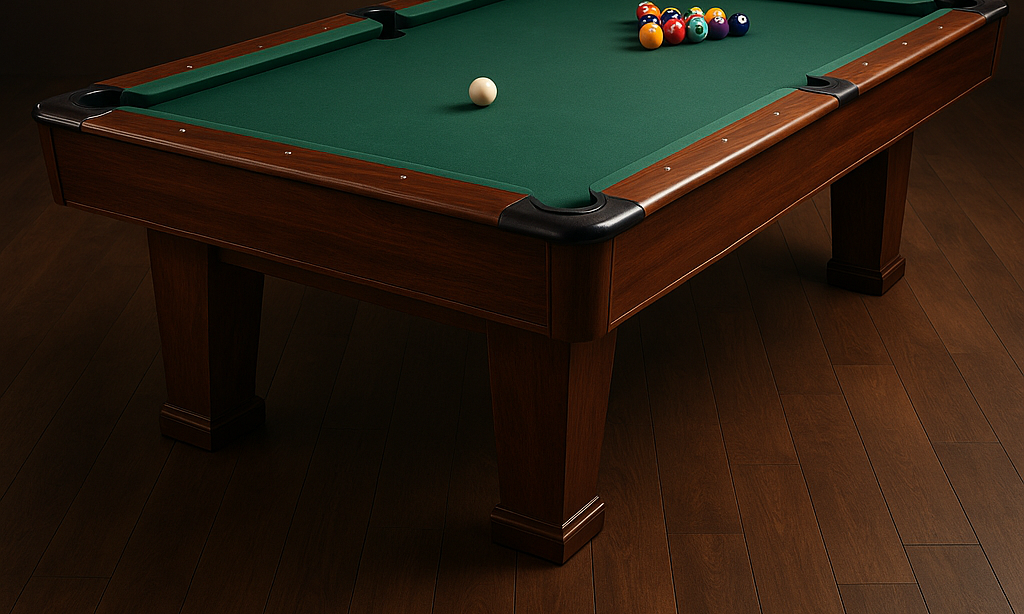
You play on a six-pocket table, usually with 16 balls: one white cue ball and 15 coloured balls numbered 1 to 15. Balls 1–7 are solids, 9–15 are stripes, and the black 8-ball sits ominously in the middle of the pack like a small sphere of doom.
The balls are arranged in a triangle with the 8-ball in the centre, a solid and a stripe in the bottom corners, and the 1-ball at the front. The cue ball sits behind the “baulk line” (that’s the line near your end of the table).
Simple enough. Until someone claims “you didn’t rack it tight enough” — the first of many phrases you’ll hear before the night’s over.
The player breaking must strike the cue ball from behind the line and hit the racked balls with enough force that something moves and at least four balls hit a cushion. If a ball goes in, they stay at the table.
If the white ball goes in, that’s a “scratch” — the pool equivalent of stepping on a rake. The other player gets to place the cue ball anywhere behind the line and take over.
And if nothing goes in, that’s fine — it just means the next person gets to spend three minutes lining up their shot like a world finalist while you pretend you meant to “open up the table”.
Once the break’s out of the way, whoever legally pots the first ball claims that group — solids or stripes. From that point, you only aim for your set. Pot your opponent’s ball, and it’s their turn. Pot the cue ball, and it’s definitely their turn.
The goal is to clear your entire group, then sink the 8-ball to win. Miss, foul, or accidentally pot the black before your time, and you lose — instantly, dramatically, and permanently.
House rules sometimes vary. Some players insist you must call your shot (“corner left!”) before the 8-ball, others don’t. The best advice is to agree before you start, ideally before the drinks arrive.
Fouls in pool are like tax laws: everyone agrees they exist, nobody can quote them precisely. The key ones:
After a foul, your opponent usually gets “ball in hand”, meaning they can place the white ball anywhere on the table. If they’re polite, they’ll just smile quietly while you stew.
The black 8-ball is the final act. You can only go for it once all your balls are cleared. You must also call the pocket if you’re playing proper rules. Pot it in the wrong one, or scratch while potting it, and the game’s over — and not in your favour.
If, however, you sink it cleanly in the declared pocket, congratulations. You’ve just won one of the most bureaucratically complicated games ever invented.
Nine-Ball: Played with balls 1–9. You must always hit the lowest-numbered ball first, but can win by potting the 9-ball at any time through a legal shot. Shorter, faster, and more chaotic.
Straight Pool: Players call each shot and score a point for every ball potted legally. The game continues until someone reaches an agreed total. It’s for people who like accounting as much as sport.
Cut-Throat Pool: Three players each take ownership of five balls. The last player with any of their numbers left on the table wins. Ideal for turning friends into rivals.
Every group, every bar, and every country seems to have its own version of American pool. And everyone believes theirs is correct.
So when you play, remember: the true test isn’t who pots the 8-ball. It’s who argues their interpretation of the rules with the most confidence.
As in politics, so in pool: the rules are perfectly clear, once you’ve rewritten them to your advantage.